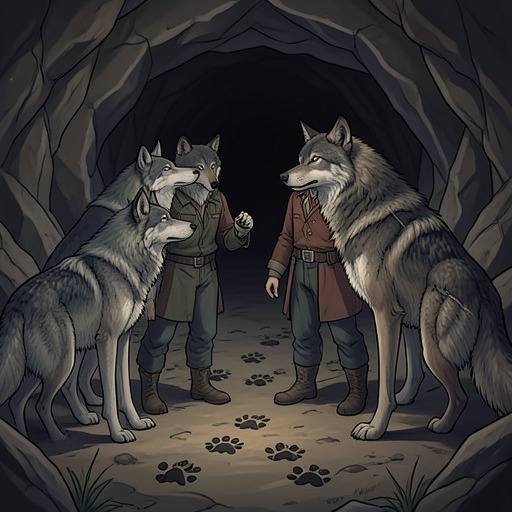
Werewolf pack secrecy rule
How to Flirt with A Naked WerewolfThe Werewolf pack secrecy rule governs who may know about the pack’s activities and its members’ lives as wolves. It is presented both as a practical protection for the village and as a firm boundary between the changing members of the pack and relatives in a Dead line. That boundary can keep dangerous information contained, but it also leaves those excluded from wolf form dependent on partial accounts of events that affect their family and community.
Scope and Rationale
Evie DuChamp explains that anything important that happens while the pack is in wolf form stays within the pack. Her own branch is a Dead line: its members cannot change, and they are not included in the pack’s wolf-form knowledge. Evie describes the restriction as applying to serious matters the pack handles for the village. In her account, limiting how many people know is a way to protect that work, rather than a rejection of dead-line relatives; she says the changing family members love them, even while withholding information from them.
The secrecy boundary reaches beyond a single incident. Evie says the pack does not discuss its business with her branch, leaving her unable to explain why Cooper Graham left the packlands or what had happened to him there. His departure had been described to the family in broad terms: the village had been endangered, Cooper defended it, and he was hurt and taking time to recover. Months later, when Evie saw him in Grundy and found him physically well but changed in manner, she still had no fuller account. She says that if Mo Duvall-Wenstein wants the truth, she should ask Cooper himself.
Knowledge, Kinship, and Exclusion
The rule operates inside a family as well as across a secretive organization. Evie’s branch remains close enough to the pack to feel its consequences, but its inability to change marks a limit on what it can be told. That distinction is sharpened by Cooper’s history: he was among the first in his generation to become a wolf, and his line had been able to change. Evie says he was expected to become his generation’s alpha because he was the fastest and strongest when he first phased. His departure and the family’s limited explanation therefore concern not only private pack affairs but the future of a leader the family had expected to remain within its community.
The book also places dead lines within a wider history of changing kinship. Cooper describes werewolf packs in different parts of the world and says dead lines have become more common as pack members marry outside the pack. Against that background, secrecy protects a smaller circle even as the circle of relatives who cannot transform grows. The rule maintains a division within an extended community: affection and kinship cross it, while access to wolf-form knowledge does not.
Trust and Selective Disclosure
Cooper’s confidence in Mo marks a significant exception to the ordinary boundary. Evie tells Mo that her family and the pack do not reveal their secret to outsiders, and that Cooper’s having trusted Mo with it means something. The disclosure is consequently more than an explanation of Cooper’s identity; it signals that he has allowed Mo across a line the pack generally keeps closed. Evie’s own conversation gives Mo context the dead-line family has not received, but it does not supply the hidden details of Cooper’s departure. She directs Mo back to him, distinguishing what she can explain from what remains pack business.
The difference between confidentiality and intimacy remains visible in Cooper and Mo’s relationship. As they grow closer, Cooper’s clothes and toothbrush appear in Mo’s home, and their shared domestic life becomes ordinary to them. Yet the secrecy rule is not simply erased by their closeness: knowledge is disclosed person by person, and Cooper’s trust in Mo is meaningful precisely because the pack normally keeps outsiders uninformed.
Secrecy as Protection and Constraint
Evie’s explanation makes the rule’s two effects inseparable. Restricting information may reduce the number of people exposed to dangerous pack affairs, which is her stated rationale. At the same time, the restriction prevents excluded relatives from understanding what has happened to their own kin. Evie knows that Cooper defended the village and was supposedly recovering, but she cannot reconcile that account with the man she later encounters in Grundy; the gap between the explanation and what she observes is itself a consequence of the rule.
The Werewolf pack secrecy rule thus sustains collective protection through controlled knowledge, while creating unequal access to family history and communal decisions. Its emotional force lies in that tension: the pack can remain loving toward its dead-line relatives and still withhold the information those relatives need to make sense of their lives. When Cooper tells Mo the secret, the act does not abolish the rule; it makes trust, rather than kinship alone, the condition for crossing its boundary.